This feature article highlights how UE Students are using AI to improve EVV Sidewalks.
by Sam Syroney
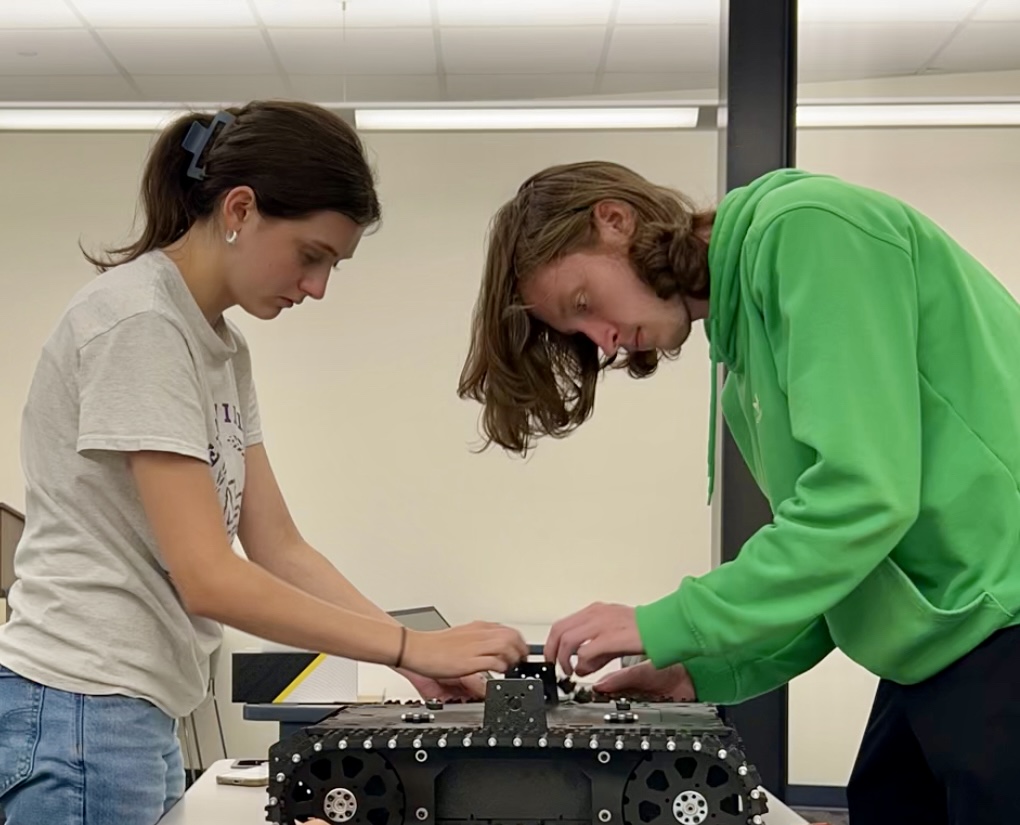
Civil engineering student Rory Schmitt and statistical & data sciences student Jake Schwaderer collaborate to assemble “Gizmo,” the primary Sidewalks4All data-collection robot.
If you live on the near-East Side of Evansville you may soon be seeing what looks like a space rover as a frequent sidewalk pedestrian. Equipped with a sophisticated GPS and an in-house developed AI as its brain, this robot, named Gizmo, is being used by the Sidewalks4All initiative to map out Evansville sidewalks to ensure they are ADA-compliant, thereby helping the City of Evansville identify community sidewalks that are in desperate need of repair.
And student learning and involvement is at the heart of it all.
Cities have well established ways to track road quality. Streets can be mapped by driving over them with special measuring equipment outfitted on city vehicles. In addition, Google Street View provides a convenient and no-cost way to visually scope out the quality of streets.
Sidewalks are a different story. In almost every community, a cracked sidewalk panel or a curb ramp are typically identified and flagged for the city via concerned residents. In Evansville, the local chapter of the American Association of Retired Persons (AARP) does a lot of work identifying and categorizing sidewalk issues through their “walk audits.” This method is beneficial, yet cannot capture all aspects of a sidewalk issue, especially when it pertains to measuring sidewalk slopes and stability. There is no sidewalk equivalent to road quality mapping, so cities end up having to be reactive to changes in sidewalk quality, instead of being proactive.
Enter our robot friend Gizmo and Sidewalks4All.
The Sidewalks4All initiative was started by University of Evansville’s Dr. Maxwell Omwenga (aka Dr. Max) from UE’s Computer Science Program and Dr. Jesus Osorio, from UE’s Civil Engineering Program. “The driving motivation behind the project is what they call the Story of One”, Dr. Max stated. “It’s a vision of empowering just one individual in a wheelchair to safely and independently navigate their neighborhood to get to school or the park.”
After meeting with community organizations, city officials, and concerned residents that all identified the sidewalk issue described above as being a major issue, they saw a unique opportunity to help the City and its residents, while also giving students a chance to work on a community issue in the classroom. The goal is to map out the entire Evansville Promise Neighborhood and, eventually, the entire City of Evansville.
Dr. Max and Dr. Osorio have provided a unique, educational initiative that gives students the chance to work on a multi-disciplinary project while simultaneously giving them the opportunity to grow their professional skills. Students and faculty from the Civil Engineering, Electrical Engineering, Computer Science, and Mathematics and Statistics Programs are all being tapped to help with the project. Students are involved in all phases of the engineering – from the design, to the training of the AI models, to the building of the robot.
Dr. Max even shared a compelling story, saying that in their newest iteration of their sidewalk-scanning bot, a student had constructed the entire robot… in one day.
Something to highlight and emphasize is the training of AI models. This new technology / tool is being embraced by Sidewalks4All as a solution to this community problem. Students train the model by walking and taking videos and photos of sidewalks on their phones. They manually draw boxes around points of concern in the media they record, with the hope of eventually gathering enough samples to train models on pattern recognition. They then hook it up to their robot, and the robot and AI work in tandem to automatically recognize where sidewalks are not up to code.
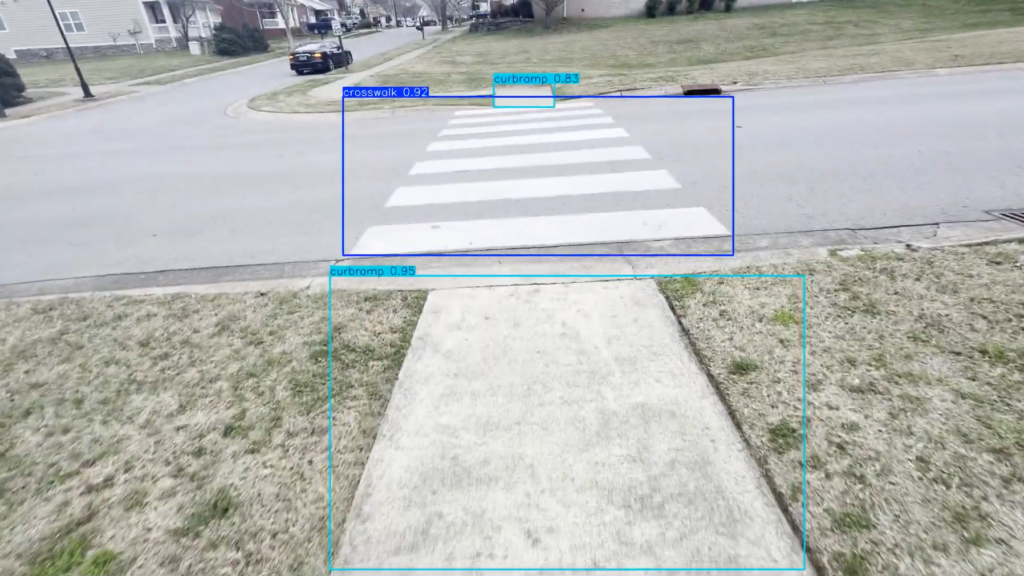
An AI-powered view of urban accessibility: A computer vision model developed by UE Machine Learning students (CS 480) maps pedestrian infrastructure with upwards of 90% confidence. By automatically identifying curb ramps, crosswalks, obstacles, and surface problems, the student-built model helps flag safe, ADA-compliant pathways across the city.
State-of-the-art tech is being used to solve our problems by our students.
And learning and experiences go beyond STEM and AI.
Students are not only involved in all phases of the engineering but also in all phases of project development and management. Dr. Max and Dr. Osorio encourage students to attend community meetings, discuss issues with stakeholders, and to present their findings to city officials, stakeholders, and community members. They learn how to work with and present to diverse audiences. Employability skills such as public speaking, teamwork and collaboration, and leadership are on full display here.
“Motivated, motivated, downright dedicated.”
That’s how Dr. Max described the students who have been involved in this project. They’re enthusiastic about having the chance to work on community projects such as this. He stated, “This project requires students who have persistence. They need to recognize this is a multi-year effort and that the project will not be easy.”
“I believe that if we give students a meaningful enough project, they will run with it,” said Dr. Osorio. “They are resonating with the feelings of belonging, community, and ownership that are coming out of working on this project.”
Both professors were incredibly excited about the future of the project and continued student development.
“Civil engineering is everywhere.” Dr. Osorio stated, “Sidewalks are a great starting point. But we can also start examining the efficiency of our light posts and the quality gaps of our community’s trails.”
“We want students to recognize that they are a part of a community bigger than themselves. When they complain about the traffic, they need to realize that they are also part of that traffic. We want them to ask themselves, What bothers me about my community? What do I think we should do to improve that problem? We want to make students curious about these problems they identify, while also empowering them to tackle those problems.”
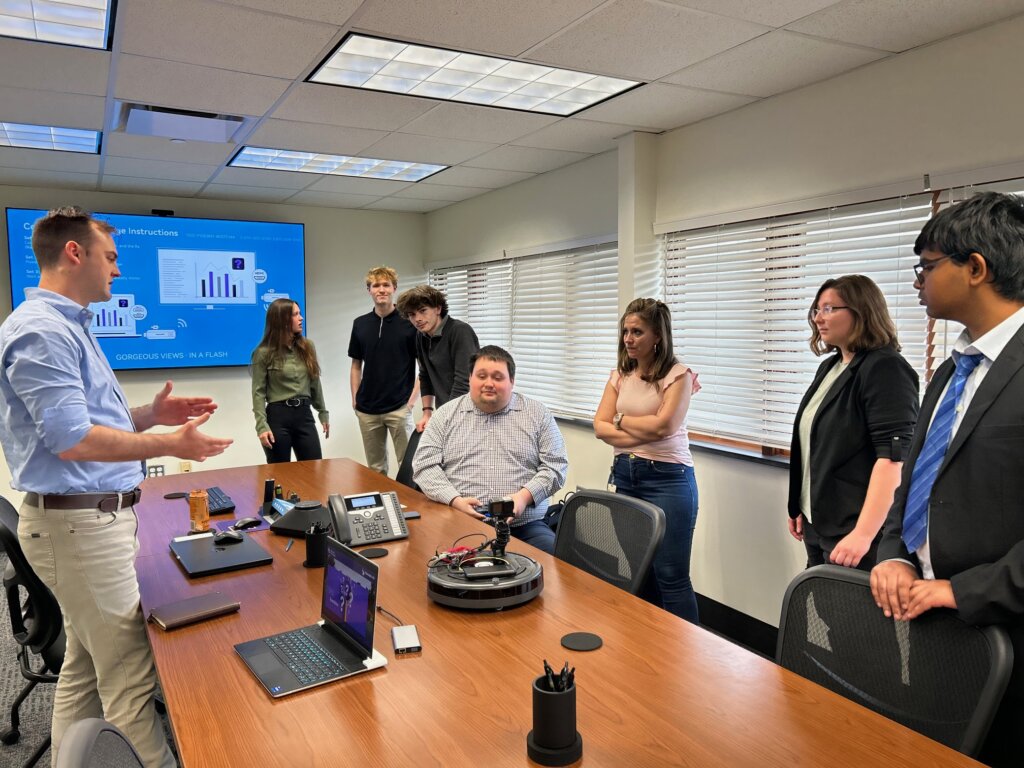
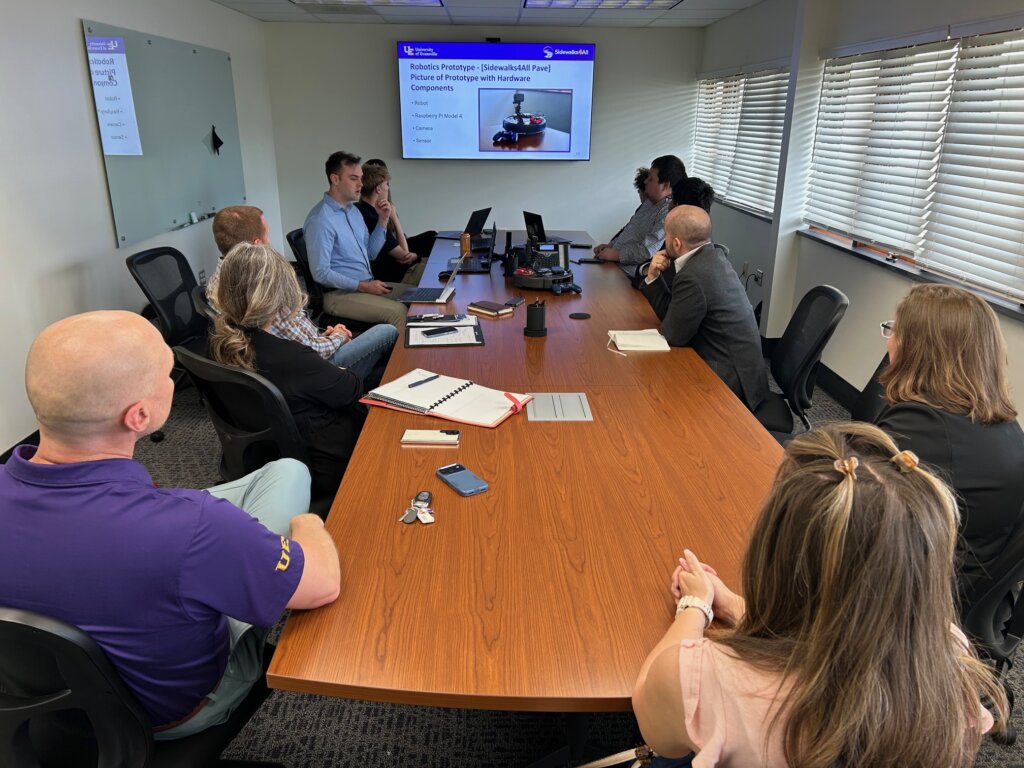
CS 480 Machine Learning students presenting their Sidewalks4All work to Evansville City Engineers, Evansville MPO, Evansville Trails Coalition, and Circular Venture Lab. Their YOLO CV models, NLP analysis of 311 data, and robotics prototype demonstrate real progress toward more ADA‑compliant sidewalks in Evansville (Photo by: Maxwell Omwenga).
Dr. Max and Dr. Osorio are looking for continued and expanded engagement with the community on their project. There are opportunities for sponsorship of full-time student employees. They’re wanting to get high schoolers and students in community organizations, like the YMCA, involved. There are also opportunities for citizens to be involved in the project as well.
By going to their Sidewalks4All website (s4a.evansville.edu), residents in the City of Evansville can upload photos of problematic sidewalks to S4A’s mobile “Walk Audit” application and identify cracks, missing crosswalks, and other hazards. This can help further train their local AI and contribute to the creation of a first-of-its-kind city map that measures sidewalk quality. No personal data or identifying information is collected or tracked.
Sidewalks4All presents our community with a unique story and opportunity to be at the forefront of using new technological innovations to solve communal issues, while ensuring our future workforce and leaders are being trained in the technology of the future and the soft skills industry needs in its workers right now.